


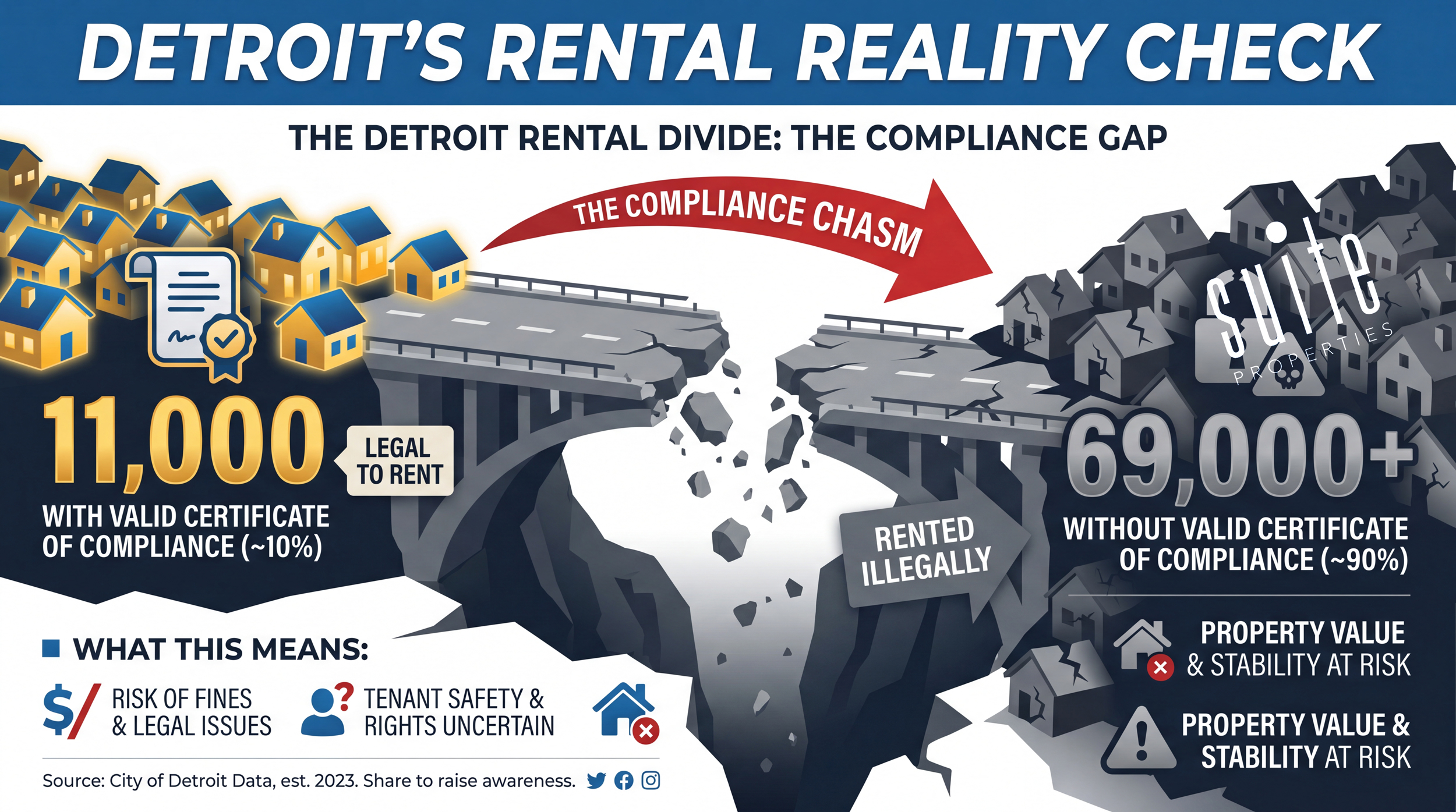
If you own rental property in Detroit, start with a number that should get your attention: of the roughly 80,000 rental properties in the city, only about 11,000 — barely more than 10 percent — currently hold a valid Certificate of Compliance. The rest are being rented illegally, whether their owners realize it or not.
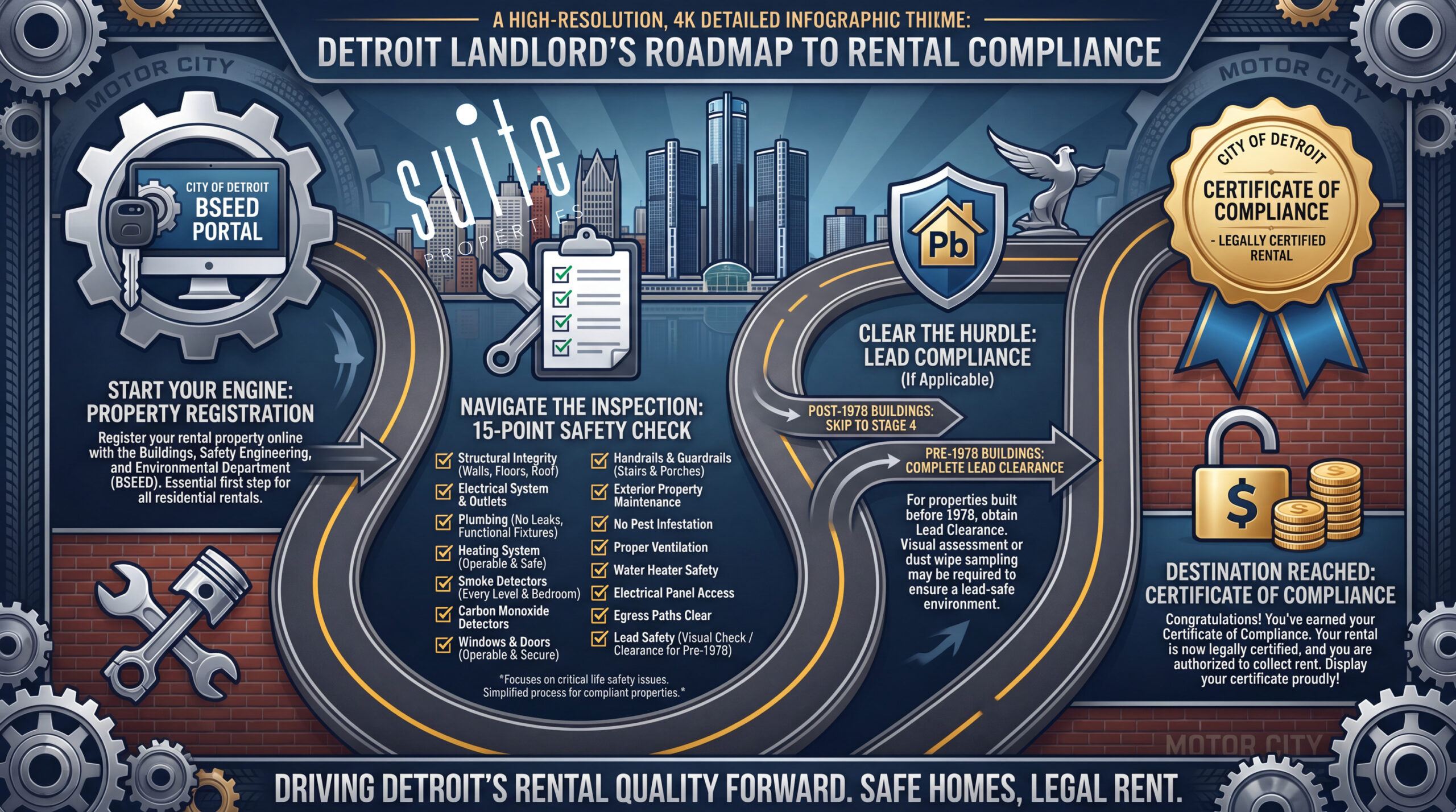
That gap doesn’t exist because compliance is impossible. It exists because, for years, the process was confusing and expensive. In October 2024, Detroit’s City Council overhauled the rental ordinance specifically to fix that — combining rental registration and certification into a single application, lowering inspection fees, and replacing a sprawling inspection with a focused 15-point checklist. The simpler process took effect January 1, 2025 and is now open to every rental property in the city, enforced by Detroit’s Building, Safety Engineering, and Environmental Department (BSEED).
The practical takeaway: becoming compliant is more achievable in 2026 than it has been in years — and the cost of staying non-compliant has never been higher. Without an active Certificate of Compliance, you cannot legally collect rent, you’re exposed to blight tickets and tenant rent-escrow, and you’re competing for good tenants against the small minority of Detroit landlords who are doing it by the book.
This guide covers exactly what BSEED compliance requires in 2026: what a Certificate of Compliance is and who needs one, the step-by-step process to earn one, the full 15-point inspection checklist, Detroit’s lead-safe rules, real costs and timelines, the escrow and penalty risks of falling behind, and the affordable-housing shortcut many owners miss.
What Is a Certificate of Compliance — and Do You Need One?
A Certificate of Compliance (often shortened to “CoC” or “C of C”) is the city’s official confirmation that your rental property was inspected and meets the minimum standards of the Detroit Property Maintenance Code and Zoning Ordinance. Under Michigan’s Housing Law (MCL 125.401 et seq.), a property must hold this certificate before it can legally be occupied as a rental. For residential properties, a Certificate of Compliance is valid for three years.
Here’s the rule of thumb on who needs one: if the property is anything other than an owner-occupied, single-family home, the city treats it as a rental and requires a Certificate of Compliance. That sweeps in more than most owners expect — single-family homes you rent out, two-family flats, apartment buildings, rooming houses, and even a single room rented inside a home you live in. The only common exemption is the house you both own and live in yourself.
One distinction trips up a lot of landlords, so it’s worth being precise: registering your property is not the same as being compliant. Rental registration is free and is simply the city’s record that your property exists as a rental. The Certificate of Compliance is the part you earn by passing inspection. You can be fully registered and still be operating illegally if you haven’t passed the inspection and received the certificate — registration is step one of the process, not the finish line.
Two more things worth knowing up front. First, the certificate attaches to a specific owner: when a property is sold or transferred, the new owner has to register and apply for their own certificate — it does not carry over. Second, and most consequentially, a property without an active Certificate of Compliance cannot legally collect rent. That single fact is what gives every other requirement in this guide its teeth, and it’s why getting certified is less an administrative chore than a precondition for running a rental business in Detroit at all.
What Is a Certificate of Compliance — and Do You Need One?
A Certificate of Compliance (often shortened to “CoC” or “C of C”) is the city’s official confirmation that your rental property was inspected and meets the minimum standards of the Detroit Property Maintenance Code and Zoning Ordinance. Under Michigan’s Housing Law (MCL 125.401 et seq.), a property must hold this certificate before it can legally be occupied as a rental. For residential properties, a Certificate of Compliance is valid for three years.
Here’s the rule of thumb on who needs one: if the property is anything other than an owner-occupied, single-family home, the city treats it as a rental and requires a Certificate of Compliance. That sweeps in more than most owners expect — single-family homes you rent out, two-family flats, apartment buildings, rooming houses, and even a single room rented inside a home you live in. The only common exemption is the house you both own and live in yourself.
One distinction trips up a lot of landlords, so it’s worth being precise: registering your property is not the same as being compliant. Rental registration is free and is simply the city’s record that your property exists as a rental. The Certificate of Compliance is the part you earn by passing inspection. You can be fully registered and still be operating illegally if you haven’t passed the inspection and received the certificate — registration is step one of the process, not the finish line.
Two more things worth knowing up front. First, the certificate attaches to a specific owner: when a property is sold or transferred, the new owner has to register and apply for their own certificate — it does not carry over. Second, and most consequentially, a property without an active Certificate of Compliance cannot legally collect rent. That single fact is what gives every other requirement in this guide its teeth, and it’s why getting certified is less an administrative chore than a precondition for running a rental business in Detroit at all.
How to Get Your Detroit Certificate of Compliance: The 3-Step Process
The 2024 reform collapsed what used to be a tangle of forms into a clean three-step sequence, all run through the city’s online portal, eLAPS (the Accela Citizen Access system). Here’s how it works for a standard 1–2 unit rental:
Step 1: Register your property
Log in to or create an eLAPS account and register the property as a rental through the Code Enforcement module, uploading the required documents (including proof of ownership). Registration itself is free, and once issued it stays valid permanently unless the property changes ownership. Remember the distinction from the last section: registering puts you on the city’s radar, but it does not make you compliant on its own.
Step 2: Pass the 15-point inspection
Pay the inspection fee inside your eLAPS account, and a third-party inspection company — assigned to you based on your property’s ZIP code — will reach out to schedule. Detroit contracts with only four certified inspection groups for 1–2 unit rentals, so you don’t get to shop around; your ZIP code determines who inspects you. As of June 2025, initial inspections and first re-inspections must be booked and paid for online through eLAPS. The inspector evaluates the property against the city’s 15-point checklist (the full list is in the next section). If anything fails, you’ll receive a correction order, make the repairs, and schedule a re-inspection to verify the work.
For properties with 3 or more units, the process is the same in spirit but scheduled differently: instead of a ZIP-assigned third party, you call BSEED directly at (313) 628-2451 to arrange the inspection.
Step 3: BSEED issues your Certificate of Compliance
Once the property passes, BSEED issues the Certificate of Compliance, valid for three years. You’re now legally clear to rent.
The whole arc, in the words of the city official who runs the program, is simply: register, schedule your inspection, make the repairs, then call back for re-inspection. The part that varies most is the middle — how quickly you pass — which usually comes down to how well-prepared the property is before the inspector ever arrives. Our step-by-step guide to getting your CoC faster breaks down how to pre-empt the most common inspection failures and avoid the re-inspection cycle that stretches the timeline by weeks.
The Detroit 15-Point Inspection Checklist: Exactly What Inspectors Look For
This is the heart of compliance, and it’s where preparation pays off. The 2024 reform replaced a long, unpredictable inspection with a focused 15-point checklist built around core life-safety and health standards. Knowing every item in advance is the single best way to pass on the first visit. Here is exactly what the inspector evaluates, in the city’s own order:
- Structural soundness — Walls and floors, including on stairs, porches, and attached decks, are free of major structural defects such as holes, rotten material, leaning, or collapsing.
- Handrails and guardrails — Securely installed and unbroken handrails on any staircase with four or more risers, and guardrails on porches.
- Weather-tight exterior — The roof, exterior walls, and gutter/downspout system keep out rain and snow.
- Working utilities — Gas and electric are on and functioning properly, with no gas leaks and reliable delivery to appliances.
- Adequate heat — The heating system is operable and can reach at least 68°F. If the tenant doesn’t control the heat, it must be maintained at that minimum.
- Safe electrical — The electrical system works properly, with no exposed wires and cover plates on every switch and outlet.
- Detectors — Smoke and carbon monoxide detectors are installed and working to manufacturer specifications.
- Hot and cold water — The water supply is operable at usable pressure, with hot water between 110°F and 140°F.
- Functional plumbing — Sinks, toilets, tubs/showers, and the water heater work, drain, and don’t leak, with the water heater vented correctly to prevent back-drafting.
- Proper egress — Every room, including any attic or basement used for living, allows safe exit, and at least one window in each bedroom is free of fixed bars.
- Operable windows — Windows designed to open work without excessive force and have locks.
- Door locks — Every entry door into a dwelling unit has a working lock.
- Pest-free — The property is free of rodent and insect infestation, including bedbugs and roaches.
- Sanitary surfaces — Floors, walls, and ceilings are clean and free of mold-like substances and sewage.
- No deteriorated paint or bare soil — No chipping or peeling paint (small amounts are allowed: under 20 sq ft outside, under 2 sq ft per interior room), and no bare soil within the home’s roofline — ground should be covered by grass, mulch, or landscaping.
That last item is doing double duty. Deteriorated paint and bare soil are also the front line of Detroit’s lead-safety enforcement — the visible signals an inspector uses to decide whether a property needs closer lead scrutiny. That’s the subject of the next section, and it’s the requirement that catches the most owners of older Detroit homes off guard. You can download the official 15-point inspection checklist directly from our website to keep on hand.
Lead-Safe Compliance: The Requirement That Catches Older Detroit Homes
Most of Detroit’s housing stock was built before 1978, which means most rentals in the city fall under lead-safety rules — and this is the area where the law has shifted the most, so it’s worth understanding clearly.
Detroit has regulated lead in rentals since 2010, and it remains, by the city’s own assessment, one of the strictest lead ordinances in the country. But how lead gets evaluated changed with the 2024 reform. The old approach leaned on a standalone lead inspection and risk assessment — annually at one point, later every three years. The current process folds lead screening into the standard inspection: the inspector performs a visual check for deteriorated paint and takes dust-wipe samples (typically at window sills and the floor in front of them), with enhanced dust sampling in properties built before 1978. This is why items like chipping paint and bare soil sit on the 15-point checklist — they’re the early-warning signals for lead.
A full lead inspection and risk assessment — the more involved, more expensive test performed by a certified lead professional — isn’t automatic for every older property anymore. It’s triggered in specific situations: when the visual or dust-wipe screening points to a problem, or when the Detroit Health Department refers a property because a child under six has been found with elevated blood lead levels. Understanding which path applies to your property is exactly where owners either save money or get blindsided.
There’s also a meaningful upside the ordinance builds in for owners who deal with lead proactively. Landlords who fully abate the lead in a property — not just paint over it, but remediate it to standard — become eligible for a 7-year Certificate of Compliance instead of the standard three. For a long-term hold, that’s a real return on the cost of abatement: fewer inspection cycles, fewer fees, and a property you can market as lead-safe.
Because lead requirements are detailed, depend on your property’s age and condition, and have changed repeatedly over the past decade, it’s worth treating this as its own project rather than an afterthought to the general inspection. Our step-by-step guide to lead-safe clearance for Detroit owners walks through exactly when a full assessment is required, how to find a certified risk assessor, what the testing involves, and how to qualify for the extended certificate.
What Detroit BSEED Compliance Actually Costs (and How Long It Takes)
| Item | Typical Cost | Notes |
|---|---|---|
| Rental registration | Free | Required first step; valid permanently unless ownership changes. |
| City inspection | ~$195 | Third-party inspector assigned by ZIP code (1–2 unit). |
| Processing fee | ~$73 | Administrative fee to issue the certificate. |
| Lead risk assessment | ~$450–$500 | Only if a full lead test is triggered; includes lab analysis. |
| Total — without full lead test | ~$270 | Property clears visual + dust-wipe screening. |
| Total — with full lead test | ~$720–$770 | Full lead risk assessment required. |
| Section 8 / affordable-housing path | ~$73 | Upload a passed program inspection; skip city inspection + lead test. |
One of the most common questions landlords have — and one your competitors’ pages rarely answer with real numbers — is simply: what does this cost, and how long does it take? Here’s the honest breakdown for a typical 1–2 unit rental.
The costs. Rental registration itself is free. From there, a standard non-Section 8 property generally faces three charges: the city inspection (commonly around $195), a small processing fee (roughly $73), and — if a full lead test is triggered — a lead risk assessment that typically runs $450 to $500, since it involves sending dust samples to a lab. So a property that needs the full lead workup lands somewhere in the neighborhood of $700–$770 all-in, while one that clears the visual and dust-wipe screening without a full assessment comes in dramatically lower, closer to $270.
That spread is exactly why preparation and lead screening matter so much: the difference between passing the visual paint and dust check versus triggering a full lead risk assessment is the single biggest swing in your total cost.
The Section 8 shortcut. If your property is already inspected through a federal, state, or local affordable-housing program, you skip both the city inspection and the lead test entirely and simply pay the processing fee (around $73) to convert your passed inspection into a Certificate of Compliance. We cover this path in detail in the Section 8 shortcut below, because it’s a saving many owners don’t realize they qualify for.
The timeline. The pace is mostly in your hands. Registration is immediate once filed. Scheduling the inspection depends on your ZIP-assigned inspection company’s availability. If the property passes clean, you can move from registration to certificate in a matter of weeks. The variable that stretches things out is failure: when violations turn up, owners are typically given a 30 to 60-day window to complete repairs before scheduling a re-inspection — and each re-inspection cycle adds time and, often, additional fees. A property that’s prepared in advance can be certified far faster than one that backs into the process and discovers problems at inspection.
A note on figures. Fee amounts here reflect what Detroit landlords and inspection vendors commonly report rather than a single published rate card, and the city periodically adjusts them. Always confirm current charges inside your eLAPS account before budgeting — and treat the numbers above as planning estimates, not quotes.
The Escrow Risk: What Happens to Your Rent If You’re Not Compliant
This is where non-compliance stops being paperwork and starts costing you money directly. The principle behind it is simple and worth stating plainly: in Detroit, you cannot legally collect rent on a property without an active Certificate of Compliance. Everything below flows from that one rule.
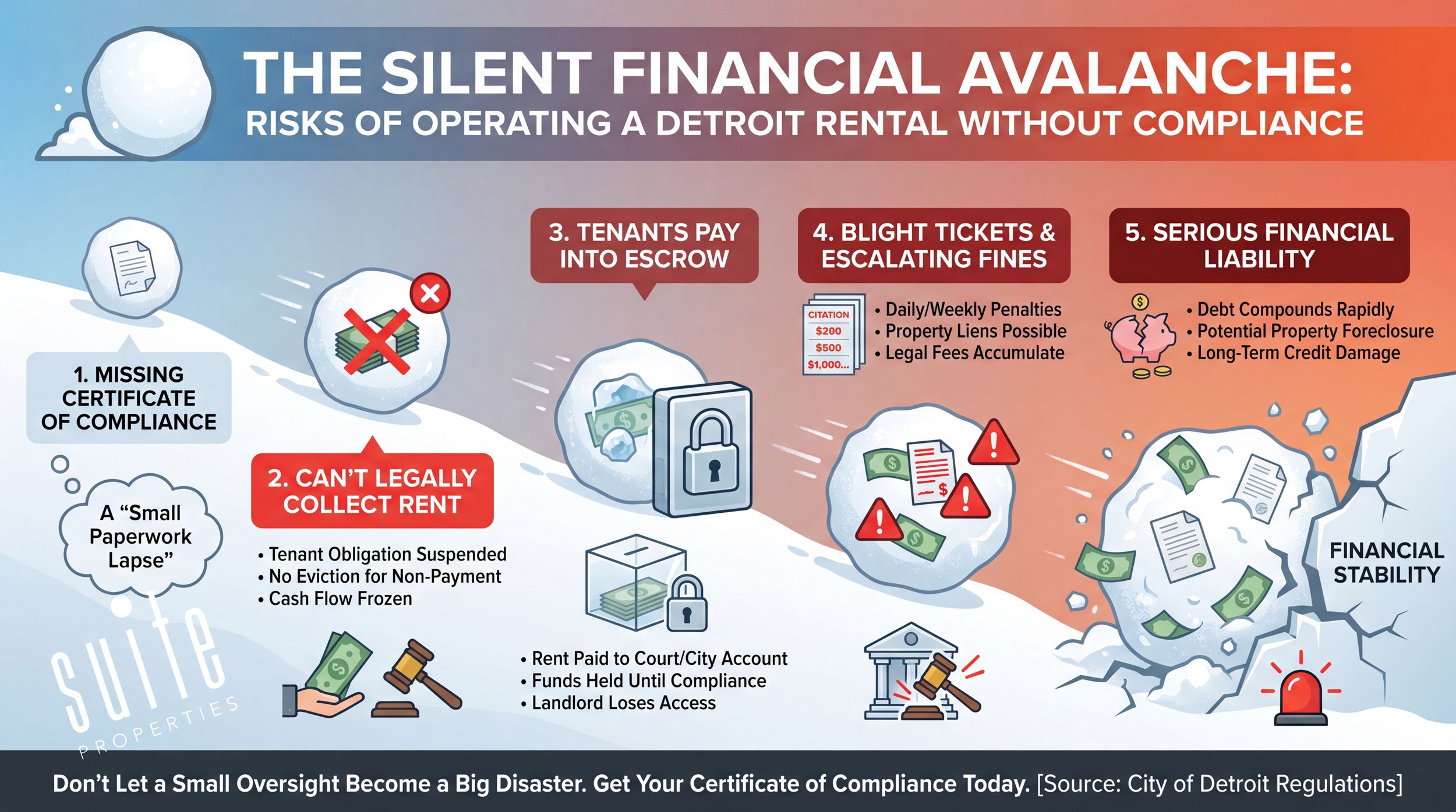
When a property isn’t compliant, a tenant has the right to pay their rent into an escrow account rather than to the landlord. The rent doesn’t disappear — the tenant is still required to deposit it — but it’s held rather than handed over, and the city reviews these escrow accounts roughly every 120 days to check whether the property has come into compliance. In practice, that means an out-of-compliance property can keep accruing rent the owner can’t actually touch until the certificate is in place. For an owner counting on that cash flow to cover a mortgage, that’s a serious problem hiding inside a paperwork lapse.
The ordinance also protects tenants from retaliation while money is in escrow, and the penalties here are concrete. A landlord who responds to an escrow situation by filing an eviction or raising the rent can be fined $650. So the escrow mechanism isn’t just a held-rent inconvenience — trying to push back against it the wrong way creates a second, separate liability.
It’s worth being measured about this rather than alarmist: in practice, relatively few Detroit tenants currently use the city’s escrow program, so this isn’t an everyday occurrence for most landlords. But it’s a standing risk that sits on every non-compliant property, and it tends to surface at the worst possible moment — during a dispute, a complaint, or a tenant who has done their homework. The reliable way to take it off the table entirely is to hold a current Certificate of Compliance, which is the throughline of this entire guide.
What Happens If You Don’t Comply
Detroit has made clear it intends to enforce these rules more aggressively, and the consequences of operating without a valid Certificate of Compliance stack up in several directions at once.
The most immediate is the one from the last section: no certificate means no legal right to collect rent, and exposure to tenant escrow. But the enforcement side carries its own teeth. Failure to register a rental property is itself treated as a blight violation — a “blight ticket” — under the city code, meaning the paperwork lapse alone is a finable offense before anyone has even looked at the condition of the property. And the city has stated plainly that paying a penalty isn’t the end of it: violators are expected to actually correct the underlying problem, and a property that stays out of compliance can draw a second or third violation, each carrying a higher fine than the last.
There’s also a faster, sharper risk for properties that are certified but slip. If an interim inspection turns up a violation that threatens a tenant’s health or safety, the Certificate of Compliance must be suspended immediately — you don’t get a grace period to fix it while continuing to operate. Unpaid fees and fines can also follow the property and the owner, and the city has avenues to pursue what’s owed, including liens. Notably, transferring or selling the property does not erase fees and fines assessed while you owned it.
The throughline across every one of these is that non-compliance compounds. A missed registration becomes a blight ticket; an uncorrected violation becomes escalating fines; held rent becomes a cash-flow problem; and an unresolved file becomes a cloud on the property itself. None of it is catastrophic on day one, which is exactly why it’s easy to let slide — and exactly why staying ahead of it is so much cheaper than catching up.
The Section 8 Shortcut: A Faster, Cheaper Path to Compliance
| Requirement | Standard Path | Section 8 / Affordable-Housing Path |
|---|---|---|
| Register in eLAPS | Yes | Yes |
| City 15-point inspection | Required | Not required |
| Separate lead test | If triggered | Not required |
| Proof submitted | Passed city inspection | Passed program inspection (<12 months old) |
| Typical cost | ~$270–$770 | ~$73 |
Here’s a provision a surprising number of Detroit landlords don’t realize applies to them — and it can save both the inspection cost and weeks of time.
If your property is already inspected through an affordable-housing program, you don’t have to go through the standard city inspection and lead test at all. Instead, you can obtain your Certificate of Compliance simply by uploading your already-passed inspection to your eLAPS account. The city accepts this path for properties inspected under Section 8, other U.S. Department of Housing and Urban Development (HUD) programs, Michigan State Housing Development Authority (MSHDA) programs, and Detroit’s own Housing and Revitalization Department programs.
The mechanics are streamlined: register the property as a rental in eLAPS as usual, attach your passed program inspection (it needs to be less than 12 months old), and BSEED issues the certificate. You skip the ZIP-assigned third-party inspection and the separate lead workup, paying only the processing fee — which is why this route can cost a fraction of the standard path.
A couple of honest caveats, because this matters for getting it right. The inspection you’re uploading has to be current — an old voucher inspection won’t qualify. And while the city accepts a passed federal inspection in place of its own, federal program standards and Detroit’s lead standards aren’t always identical, so a property that cleared a Section 8 inspection should still be genuinely lead-safe, not just paperwork-compliant. The shortcut saves you the city’s process; it doesn’t lower the underlying safety bar.
For owners with voucher tenants — a meaningful share of Detroit’s rental market — this is one of the most valuable efficiencies in the entire compliance system, and it’s worth confirming whether your existing inspections already qualify you before you pay for a redundant city inspection.
How Suite Properties Keeps Your Detroit Rentals Compliant
Everything above is doable on your own — but it’s a recurring, detail-heavy process that repeats every three years per property, with real money and your legal right to collect rent riding on getting it right. That’s the work Suite Properties handles for owners day in and day out.
We specialize in managing portfolios of four or more units, which means BSEED compliance isn’t an occasional scramble for us — it’s a standing system. We register properties, prepare them to pass the 15-point inspection the first time, coordinate inspections and any lead screening, keep certificates current ahead of their three-year expiration, and stay on top of the requirements as the ordinance continues to evolve. For owners with voucher tenants, we also manage the Section 8 compliance path, including the inspection shortcut that can save you the cost and delay of a redundant city inspection.
“The single biggest mistake I see Detroit owners make is treating bare soil and a little peeling paint as cosmetic. Those are the exact things that decide whether you pass the visual screening or get pushed into a five-hundred-dollar lead assessment. We fix them before the inspector ever pulls up.”
— Eric Wizenberg, Founder & Principal, Suite Properties
Owners aren’t the only ones who notice the difference. As one client put it:
“I haven’t even moved into my property yet and I already feel very much so at home — like family — with Suite Properties. Monica has been so helpful and persistent getting paperwork and things done on my behalf. I couldn’t ask to be with a better company. 10 out of 10, highly recommend.” — Britany, Google Review
If you own rental property in Detroit and want compliance handled correctly and continuously — not rediscovered at inspection time — contact Suite Properties to talk through your portfolio.
Detroit BSEED Compliance: Frequently Asked Questions
Do I need a Certificate of Compliance to rent out my house in Detroit?
Yes. Any property that isn’t an owner-occupied single-family home is treated as a rental and needs a Certificate of Compliance before it can legally be occupied — including single-family rentals, two-family flats, apartment buildings, rooming houses, and even a single room rented inside a home you live in.
How long is a Detroit Certificate of Compliance valid?
Three years for residential properties. Owners who fully abate lead in a property can qualify for an extended 7-year certificate.
Is rental registration the same as being compliant?
No. Registration is free and simply records your property as a rental with the city. You’re only compliant once the property has passed inspection and BSEED has issued the Certificate of Compliance. You can be registered and still be renting illegally.
How much does it cost to get a Certificate of Compliance in Detroit?
For a typical 1–2 unit property, registration is free, the city inspection commonly runs around $195, and there’s a processing fee of roughly $73. If a full lead risk assessment is triggered, that test typically adds $450–$500. Fees change periodically, so confirm current amounts in your eLAPS account before budgeting.
Can a tenant stop paying rent if my property isn’t compliant?
A tenant can pay rent into an escrow account rather than to you, and the city reviews those accounts about every 120 days. The money isn’t forfeited by the tenant, but you can’t collect it until the property is compliant — and retaliating with an eviction or rent increase during escrow can bring a $650 fine.
Does my property need a lead inspection?
Most Detroit rentals were built before 1978 and fall under lead-safety rules. Under the current process, lead is screened through a visual check for deteriorated paint and dust-wipe testing during the standard inspection. A full lead risk assessment is required in specific cases — such as when screening flags a problem or the Health Department refers a property because a child under six has elevated blood lead levels.
I have Section 8 tenants. Do I still need a city inspection?
Not necessarily. If your property passed an inspection through Section 8, another HUD program, MSHDA, or Detroit’s Housing and Revitalization Department, you can obtain your certificate by uploading that passed inspection (less than 12 months old) to eLAPS — skipping the separate city inspection and lead test.
What happens if I just don’t get certified?
You can’t legally collect rent, you’re exposed to tenant escrow, and failing to register is itself a blight violation. Repeat violations carry escalating fines, health-or-safety violations can suspend a certificate immediately, and unpaid fines can follow the property — including after a sale.
How long does the whole process take?
If the property passes clean, you can move from registration to certificate in a few weeks; the pace depends largely on your assigned inspection company’s availability. If violations are found, owners typically get 30–60 days to make repairs before re-inspection, and each re-inspection cycle adds time.
The Detroit rental ordinance has changed several times in recent years and continues to evolve. This guide reflects the requirements as of 2026, but always confirm current rules through your eLAPS account or directly with BSEED before making decisions about your property.
Connect with Suite Properties on social media: Facebook | LinkedIn
Official Detroit BSEED Resources
- BSEED Landlord Rental Requirements — the city’s main landlord compliance page.
- Rental Certificate of Compliance — step-by-step process and the 15-point checklist.
- eLAPS Portal (Accela Citizen Access) — register your property, pay fees, and schedule inspections.
