


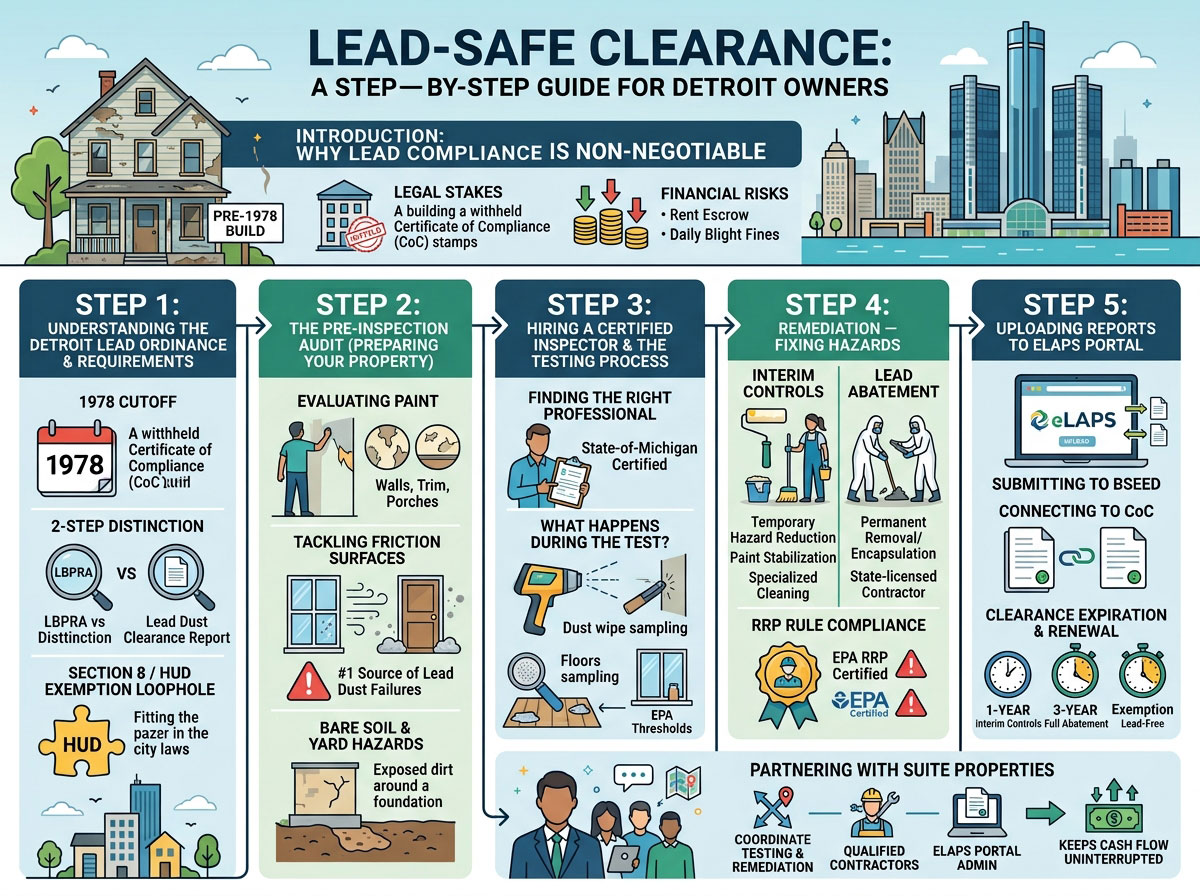
Securing lead clearance quickly is the single most effective way to protect your tenants, preserve your cash flow, and keep your property operating legally within the city of Detroit.
Step 1: Understanding the Detroit Lead Ordinance & Requirements
Determining Detroit’s lead compliance process begins with understanding the specific legal framework governing residential rentals. City ordinances do not treat every rental property the same, and misunderstanding the exact testing requirements can lead to failed inspection filings and wasted investment capital.
The 1978 Cutoff Date
The foundational rule of Detroit lead compliance centers on the year 1978. Because the federal government banned residential lead-based paint in 1978, all residential rental properties constructed prior to 1978 are legally subject to Detroit’s lead compliance mandate. If your property was built in 1978 or later, you are generally exempt from lead risk assessments, though you must provide proper federal disclosure documentation to incoming tenants.
The Two-Step Distinction: LBPRA vs. Clearance Report
Landlords frequently conflate two distinct lead compliance documents required by the city:
- Lead-Based Paint Inspection & Risk Assessment (LBPRA): This is the initial diagnostic evaluation. A state-certified inspector evaluates all painted surfaces using specialized XRF (X-Ray Fluorescence) technology to determine where lead paint exists. A risk assessor then tests dust, soil, and paint condition to locate active hazards. The resulting LBPRA report identifies the exact locations requiring repair or hazard control.
- Lead Dust Clearance Report: This is the post-work verification document. Once any identified lead hazards are properly addressed, a certified inspector conducts visual inspections and takes dust wipe samples from floors, window sills, and window troughs. When laboratory analysis confirms dust levels fall below state and federal safety thresholds, a Lead Clearance Report is issued. This Clearance Report is the document required by BSEED to grant your Certificate of Compliance.
The HUD & Section 8 Inspection Interplay
If you participate in housing choice voucher programs (such as Section 8 administered through MSHDA or the Detroit Housing Commission), your property undergoes federal physical inspections. While BSEED accepts passed HUD/Section 8 inspection reports to satisfy standard building inspections, federal housing inspections do not automatically substitute for a Detroit Lead Clearance Report unless a full, certified lead dust clearance was completed during that inspection cycle.
Landlords must ensure their federal documentation includes a valid, laboratory-verified lead dust clearance before relying on it for local Detroit eLAPS portal approval.
Step 2: The Pre-Inspection Audit (Preparing Your Property)
The fastest way to fail a lead clearance test—and incur expensive laboratory re-testing fees—is to schedule the inspector before properly prepping the home. A pre-inspection audit allows landlords to catch and correct obvious hazards beforehand.
Evaluating Surface Paint Condition
Inspectors perform a strict visual inspection before taking any physical samples. Any cracking, flaking, peeling, or chipping paint on a pre-1978 rental is an automatic visual failure.
- Interior & Exterior Walls: Check all rooms, ceilings, baseboards, and trim. Pay special attention to exterior porches, columns, and soffits, which are frequently exposed to heavy weather.
- Intact Paint Standard: All painted surfaces must be 100% intact, smooth, and fully sealed. If paint is peeling, it must be properly scraped, primed, and repainted using lead-safe work practices before testing.
Tackling Friction Surfaces (The #1 Source of Clearance Failures)
Friction surfaces generate microscopic lead dust every time they move, making them the most common reason properties fail dust wipe tests.
- Windowsills & Window Troughs: Opening and closing old wooden windows grinds lead paint into fine dust. Clean all interior sills and well troughs thoroughly with a HEPA vacuum followed by a wet wipe using a lead-specific detergent or standard all-purpose cleaner.
- Door Jambs & Hinges: Inspect door frames where the edge of the door rubs against the jamb. Ensure painted edges are scraped smooth, lubricated, or repainted so movement no longer creates friction dust.
- Stairs & Handrails: Banisters, guardrails, and stair treads absorb constant physical contact and foot traffic. Ensure railings are tightly secured and painted surfaces are sealed completely.
Bare Soil & Yard Hazards
Lead hazards are not confined to the interior of the home.
- Foundation Perimeter: Rain runoff from historic exterior lead paint often accumulates in the soil surrounding the foundation.
- Exposed Soil Mandate: Under Detroit guidelines, bare soil near pre-1978 structures cannot be left exposed. Landlords must cover exposed ground within the drip line of the house using grass seed, sod, wood chips, gravel, or paving to pass the environmental inspection.
Step 3: Hiring a Certified Inspector & The Testing Process
Once your property is prepped and clean, the next step is scheduling your official lead clearance test. Performing this evaluation requires specific credentials—Detroit BSEED will automatically reject any lead report that is not produced by a properly licensed state professional.
Finding a State-Certified Inspector
In Michigan, you cannot hire a general home inspector or contractor to perform lead hazard evaluations or issue a clearance.
- State Credentialing Required: Your inspector must be officially certified as a Lead Inspector or Lead Risk Assessor by the State of Michigan Department of Health and Human Services (MDHHS).
- Verification: Before booking, request the inspector’s state certification number or verify their credentials through the MDHHS “Mi Lead Safe” registry.
What Happens During the On-Site Evaluation?
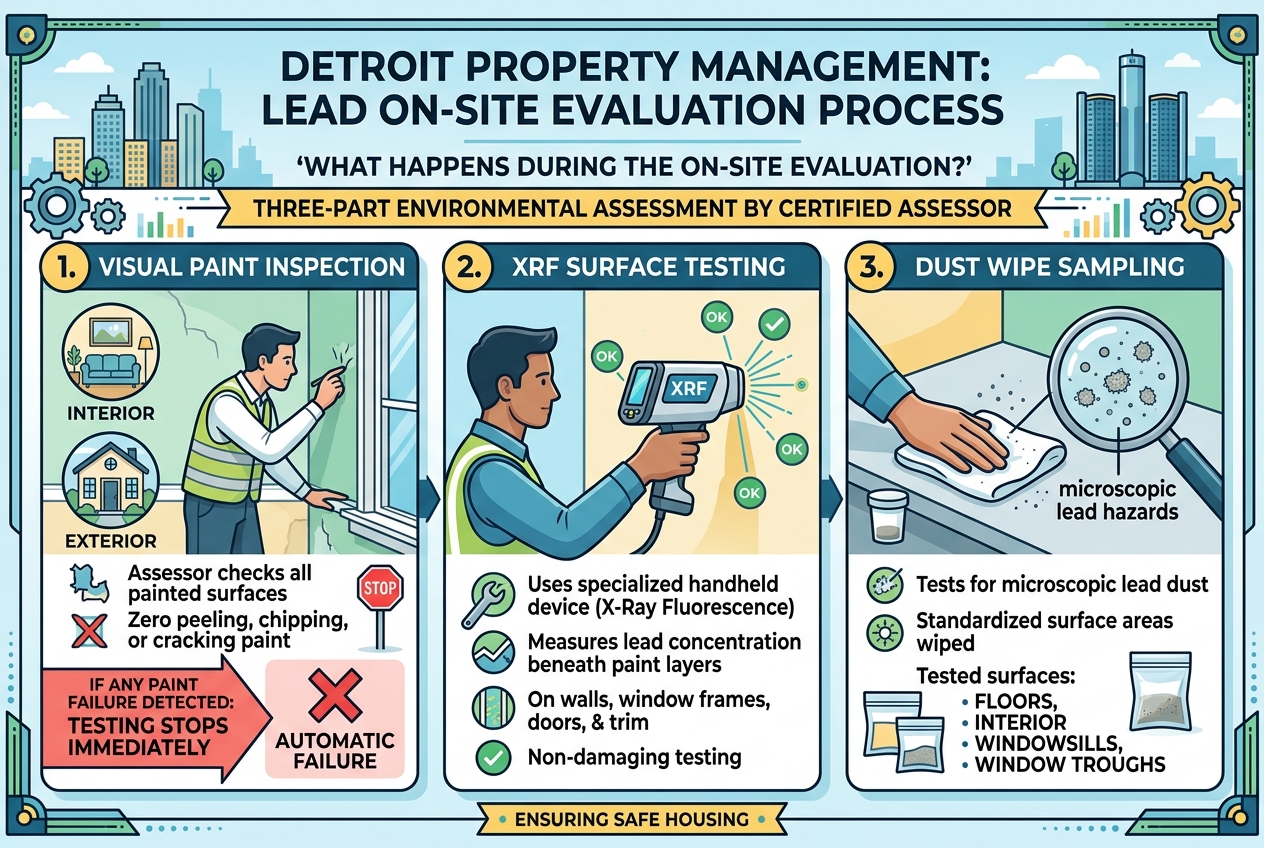
During the inspection, the certified assessor conducts a three-part environmental assessment:
- Visual Paint Inspection: The inspector reviews all interior and exterior painted surfaces to confirm zero peeling, chipping, or cracking paint exists. If any paint failure is detected visually, the testing stops immediately, resulting in an automatic failure before samples are even collected.
- XRF Surface Testing: Assessors use an X-Ray Fluorescence (XRF) analyzer—a specialized handheld device—to measure lead concentration beneath layers of paint across walls, window frames, doors, and trim without damaging the surfaces.
- Dust Wipe Sampling: To test for microscopic hazards, the inspector wipes standardized surface areas on floors, interior windowsills, and window troughs using specialized dust sampling wipes.
Laboratory Analysis & Passing Thresholds
Once collected, dust wipes are sent to an EPA-recognized laboratory for chemical analysis. The lab measures lead dust concentration in micrograms per square foot (µg/ft²). To receive a Lead Dust Clearance Report, the lab results must meet or fall below federal and state safety limits:
- Floors: Less than 10 µg/ft²
- Interior Windowsills: Less than 100 µg/ft²
- Window Troughs (Wells): Less than 100 µg/ft²
If all samples meet these safety standards, the inspector issues your official Lead-Safe Clearance Report. If any sample exceeds the threshold, the property fails, and the specific areas must undergo targeted remediation before a re-test.
Step 4: Remediation — Fixing Hazards (Interim Controls vs. Abatement)
If your pre-inspection audit or initial lab report reveals lead hazards, you must complete targeted remediation before a clearance can be issued. In Detroit, hazard remediation falls into two distinct categories recognized by the city and state: Interim Controls and Abatement.
Interim Controls (Temporary Hazard Reduction)
Interim controls are designed to address immediate lead hazards temporarily without permanently removing the underlying paint.
- Common Methods: Paint stabilization (scraping, priming, and repainting chipping surfaces), specialized heavy-duty cleaning using HEPA vacuums, and installing protective covers over friction points.
- When to Use: Ideal for properties where paint is mostly intact and hazards are isolated to minor surface deterioration.
- Impact on Clearance: Choosing interim controls qualifies your property for a 1-year Lead Clearance Report, meaning the property must be re-tested annually to maintain compliance.
Lead Abatement (Permanent Hazard Elimination)
Abatement involves permanently eliminating lead paint hazards or completely encapsulating lead-bearing building components.
- Common Methods: Enclosing exterior walls with vinyl siding, replacing historic wooden windows with modern vinyl units, stripping paint down to bare wood, or installing permanent encapsulation barriers.
- Required Contractor: Abatement work cannot be performed by general handymen or property owners. It must be completed by a State-of-Michigan Licensed Lead Abatement Contractor.
- Impact on Clearance: Successfully completing certified abatement grants your property a 3-year Lead Clearance Report or potential full exemption status, significantly reducing long-term administrative overhead.
The EPA RRP Rule Mandate
Whether you utilize interim controls or full abatement, any contractor performing work that disturbs painted surfaces in a pre-1978 home must comply with the Environmental Protection Agency’s Renovation, Repair, and Painting (RRP) Rule.
- RRP Certification: Contractors must be EPA RRP certified, utilizing plastic containment barriers, HEPA dust extraction equipment, and wet-shaving techniques.
- Preventing Contamination: Uncertified contractors using standard power sanders or dry scraping techniques scatter fine lead dust throughout the property, practically guaranteeing an expensive clearance failure and requiring costly professional decontamination.
Step 5: Uploading Clearance Reports to the eLAPS Portal
Once your inspector delivers a passing Lead-Safe Clearance Report, the final administrative milestone is getting that documentation approved by the city. Physical paper copies are not accepted at BSEED counters; all compliance documentation must be processed electronically.
Navigating the eLAPS Submission Pipeline
- Access Your eLAPS Account: Sign in to the City of Detroit Electronic Licensing and Permitting System (eLAPS) under your Code Enforcement or Property Maintenance registration module.
- Locate Your Property Record: Search for your specific property parcel number or rental registration record ID.
- Upload Official Documents: Attach a full, legible PDF copy of your Lead Clearance Report, ensuring the lab results, inspector’s state license number, and property address match your registration record exactly.
- Verify Inspector Credentials: BSEED cross-references uploaded reports against the state registry. If your inspector failed to include their MDHHS license verification or used an outdated report template, the portal will flag the upload as incomplete.
Linking Lead Clearance to Your Building Inspection
A common reason for delayed compliance certificates is uploading the lead clearance without tying it to an open building inspection ticket.
To release your final Certificate of Compliance (CoC):
- Ensure your physical 15-point property inspection is either completed or scheduled with BSEED/third-party inspectors.
- Once BSEED reviews your uploaded lead clearance PDF and verifies that the physical inspection passed, the system automatically clears the lead hold on your account and issues your CoC.
7. Clearance Expiration & Renewal Timelines
Securing your initial Lead Clearance Report is a major milestone, but lead compliance is an ongoing obligation for Detroit property owners. How long your lead clearance remains valid—and how often you must re-test—depends directly on the remediation strategy you chose during the clearance process.
Annual (1-Year) Renewal: Interim Controls
If your property passed its lead clearance after utilizing interim controls (such as paint stabilization, surface sealing, or specialized cleaning), your lead clearance is valid for 1 year.
- Re-Assessment Mandate: Detroit City Code requires an annual lead risk re-assessment and a new dust wipe clearance to keep your Certificate of Compliance active.
- Why the Short Window? Because temporary controls do not permanently remove lead-based paint, normal wear, friction, and environmental exposure can cause sealed surfaces to deteriorate over time, re-introducing dust hazards.
3-Year Renewal: Certified Abatement
If lead hazards were remediated using certified lead abatement methods (such as window replacement, component removal, or permanent enclosure barriers), your Lead Clearance Report is valid for 3 years.
- Extended Validity: Aligning with Detroit’s 3-year residential Certificate of Compliance cycle, a 3-year clearance reduces administrative back-and-forth and testing costs for property owners.
- Required Documentation: To maintain the 3-year schedule, your initial clearance submission on eLAPS must include verification that the remediation was performed by a State-of-Michigan Licensed Lead Abatement Contractor.
Full Exemption Status: Lead-Free Certification
If an initial Lead Inspection/Risk Assessment (LBPRA) demonstrates that a pre-1978 building contains zero lead-based paint, or if a property undergoes complete abatement of all lead-based paint under state standards, the property achieves full exemption status.
- No Further Testing Required: Once certified lead-free by a state-licensed risk assessor and recorded with BSEED, the property is permanently exempt from future lead inspections and clearance renewals.
8. Partnering with Professionals: How Suite Properties Protects Your Investment
Managing lead compliance while running a profitable rental portfolio in Detroit requires constant vigilance. From coordinating state-certified inspectors and EPA RRP contractors to tracking eLAPS portal approvals and expiration dates, a single missed step can freeze your rent collections and trigger costly penalties.
Partnering with Suite Properties takes the friction out of Detroit lead compliance. As a full-service Detroit property management firm, we safeguard your portfolio by:
- Pre-Screening Properties: Performing thorough pre-inspection audits to catch paint deterioration and friction hazards before official testers arrive.
- Managing Certified Networks: Leveraging vetted, state-licensed lead risk assessors and EPA RRP-certified repair crews to guarantee quality work at competitive rates.
- Handling Portal Administration: Submitting all required lead clearance reports, property transfer affidavits, and inspection paperwork directly to BSEED via eLAPS.
- Protecting Cash Flow: Ensuring your Certificate of Compliance remains active so your rental income stays consistent, legal, and fully protected.
9. Frequently Asked Questions (FAQ)
How much does a Lead Risk Assessment and Clearance cost in Detroit?
An initial Lead-Based Paint Inspection & Risk Assessment (LBPRA) for a single-family home typically costs between $300 and $500. A follow-up Lead Dust Clearance Report (including lab analysis of wipe samples) generally ranges from $150 to $300. If lead hazards are identified, repair and remediation costs will vary based on whether you choose interim controls or full abatement.
Can I perform lead paint repairs or dust cleanups myself?
For minor interim controls in a single-family home you personally own, you can perform basic surface cleaning and paint touch-ups, provided you use lead-safe work practices. However, if you hire outside help, federal law requires contractors to be EPA RRP-certified. Furthermore, major lead abatement work must be completed by a State-of-Michigan Licensed Lead Abatement Contractor. Standard dry sanding or uncontained repairs will scatter hazardous dust and lead to clearance failures.
What happens if my tenant refuses access for lead testing or repairs?
Under Michigan lease standards and Detroit city ordinances, landlords have the right to access the property for required maintenance and legal compliance inspections after providing proper written notice (typically 24 to 48 hours). If a tenant repeatedly refuses access, document all written communication attempts, notice deliveries, and inspector scheduling logs. This documentation serves as legal proof of your good-faith efforts if you need to petition the court or request a compliance extension from BSEED.
